
If you’ve been around SAP MM Training for the past few years, you may have noticed a change. The learning path used to be structured and full of modules, but now it is becoming more flexible, faster, and surprisingly easy to understand. Artificial intelligence is the main thing that has caused that change.
SAP MM (Materials Management) has always been one of the most useful and popular modules in the SAP ecosystem. But AI isn’t just changing how businesses use SAP; it’s also changing how people learn it in a big way.
I’ve been keeping a close eye on this change by talking to students, trainers, and people who work in the field. Today’s AI-enhanced learning is very different from traditional SAP MM training. It’s like reading a manual and having a mentor with you all the time.
If you’re planning to learn SAP MM now, let’s look at what’s really going on and why it matters.
Connect With Us: WhatsApp
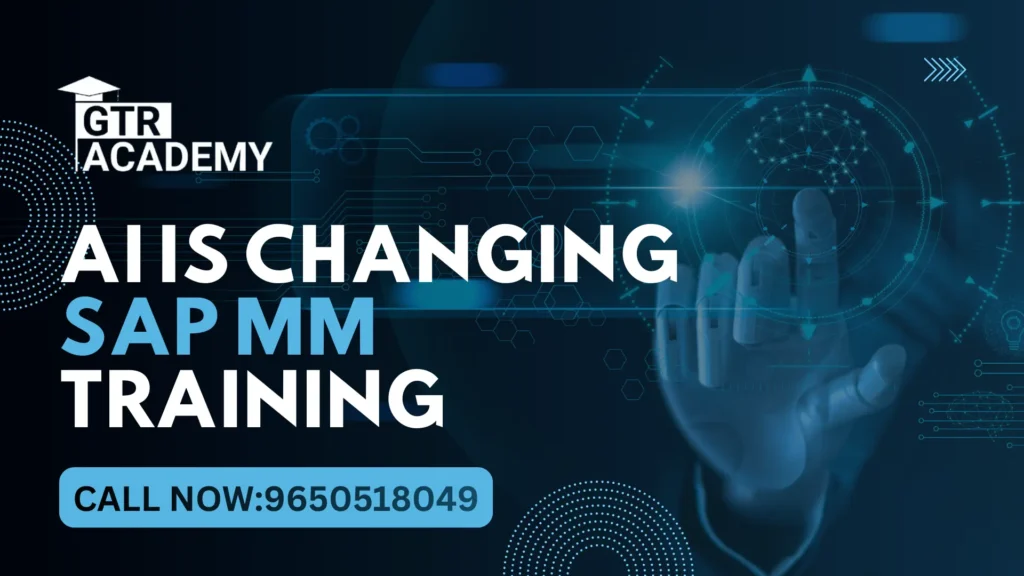
The Change from Static Learning to Smart Learning
The usual way to teach SAP MM was through lectures, case studies, system practice, and tests. It worked, but it wasn’t tailored to the individual. No matter what their background or way of learning, everyone moved at the same speed.
That is all changing because of AI.
Today’s training environments can figure out how you learn, what you have trouble with, and what ideas you need to work on more. Instead of going over whole modules again, students get help exactly where they need it.
Think about how useful it would be to practice procurement configuration and get feedback on mistakes right away, before they become habits. That isn’t just a theory anymore; it’s already happening on modern SAP learning platforms.
How Generative AI is Changing the Way People Learn SAP MM Skills
The use of generative AI to help people learn complicated SAP processes is one of the most exciting changes.
To understand SAP MM, you need to know how to handle workflows like:
- Purchase requisitions
- Vendor evaluations
- Inventory management
- Invoice verification
These steps aren’t just technical; they require process thinking.
Generative AI is helpful because it can mimic real-life business situations. Instead of memorizing transaction codes, students work on problems that change over time:
- Dealing with problems in the supply chain
- Choosing the best vendors
- Handling stock problems
- Making decisions about buying things automatically
This makes the training feel more like real job duties than studying for a test.
Better Ways to Get Ready for Certification
It used to be stressful to get ready for SAP MM Certification because there weren’t many practice materials and they didn’t change. AI-driven platforms now make question sets that change based on how well people do.
That means that if you keep having trouble with valuation procedures or material master configuration, your training system will automatically put more emphasis on those topics.
You might also see new learning materials that are in line with what people are talking about in the industry, like:
- SAP Business AI certification topics
- SAP and AI integration
- SAP AI Core service
- SAP AI Engineer skill development
- SAP Generative AI certification focus
These topics show how certification is changing as AI technology improves.
The Role of SAP AI Core in Training Settings
The SAP AI Core infrastructure can now be used in more than just businesses. Training platforms are adding smart services that mimic large-scale business decision-making.
The SAP AI Core service is very important here. It lets training environments show how AI models work in SAP landscapes, not just in theory but also through hands-on demonstrations.
Students can see how:
- Predictive demand forecasting affects purchasing
- Intelligent document processing simplifies invoice capture
- AI-driven insights help maintain optimal inventory levels
This bridges the gap between knowing how to use SAP MM and running a smart business.
The Real Way to Learn SAP MM
- One of the biggest problems with older training models was that classroom exercises didn’t match real corporate workflows.
- AI-based training fills that gap.
- Instead of doing separate tasks, students work through end-to-end scenarios that reflect real business operations:
- A manufacturing company runs out of raw materials, triggering procurement strategy changes, vendor risk analysis, inventory rebalancing, and financial impact review.
- That’s how SAP MM works in the real world. AI-driven simulations help students get used to complicated situations before they start working professionally.
Why Professionals Are Moving to AI-Integrated Training Institutes
Some training centers haven’t adapted to these changes. But the ones that have are delivering better results.
GTR Academy stands out because it integrates AI directly into SAP MM Classes instead of teaching AI as a separate topic. Their programs include:
- Scenario-based learning
- AI-powered practice environments
- Certification-focused preparation
- Real business case simulations
Students don’t just learn SAP MM they understand how intelligent ERP systems function in real enterprises.
This difference shows in student confidence. Learners report feeling ready not just for exams, but for real-time projects.
The Growth of the SAP AI Engineer Skill Set
Functional consultants and AI-enabled professionals are beginning to collaborate more closely.
You don’t have to be a data scientist to use AI in SAP. But understanding how AI supports procurement, forecasting, and automation is becoming a competitive advantage.
Training programs are introducing the concept of a SAP AI Engineer someone who understands both business processes and intelligent systems.
For SAP MM professionals, this means:
- Data-driven decision-making
- Using smart procurement tools
- Interpreting predictive analytics
- Collaborating with AI technical teams
This blended skill set is increasingly attractive to employers.
Cost-Effective Training and SAP AI Credits
Another practical advantage of AI-driven training is cost optimization.
Some learning platforms simulate enterprise AI usage models, including concepts like SAP AI credits. This helps students understand ROI calculations when companies implement intelligent services.
Instead of viewing AI as abstract technology, trainees learn how businesses manage:
- AI resource allocation
- Commercial licensing structures
- Cost benefits of intelligent automation
This business understanding makes training more aligned with leadership expectations.
The Human Side of AI-Based SAP Learning
- Despite all the technology, one truth remains: people learn best with context, storytelling, and mentorship.
- AI does not replace trainers it enhances them.
- Trainers now spend less time repeating theory and more time guiding strategic thinking. Classrooms are becoming interactive and dynamic.
- Students feel less overwhelmed because AI provides instant clarification when concepts become confusing.
- Confidence accelerates learning more than any manual ever could.
What This Means for Future SAP MM Professionals
- The role of a SAP MM consultant is expanding.
- Companies no longer want professionals who only configure systems. They want experts who understand how intelligent enterprise systems influence business decisions.
AI-powered training prepares students for:
- Automation-aware procurement strategies
- Predictive inventory management
- Intelligent supplier evaluation
- Data-driven process optimization
SAP MM is shifting from operational support to strategic impact.
And training is finally catching up.
Frequently Asked Questions (FAQs)
1. How does SAP MM training really use AI?
AI customizes learning paths, creates adaptive practice scenarios, and simulates real business environments to provide practical exposure.
2. Do you need AI knowledge to learn SAP MM?
No prior AI knowledge is required, but understanding AI concepts enhances career opportunities.
3. Does AI make SAP certification easier?
AI doesn’t make certification easier it makes preparation smarter and more focused.
4. How does generative AI fit into SAP training?
Generative AI creates evolving business cases and adaptive practice questions tailored to learners’ weaknesses.
5. Why is SAP AI Core useful for students?
It demonstrates how AI models operate within SAP enterprise systems.
6. Can AI replace SAP trainers?
No. AI supports trainers by providing intelligent tools and performance insights.
Connect With Us: WhatsApp
Conclusion
AI is not only improving SAP S/4HANA MM Certification it is redefining what it means to be a SAP professional.
Learning is becoming personalized, practical, and aligned with real business workflows. Certification preparation is smarter. Skill expectations are evolving. And professionals who integrate AI into their training are future-proofing their careers.
The key takeaway is simple: SAP MM knowledge alone is no longer enough. The new competitive advantage lies in understanding how intelligent systems enhance business processes.
Choosing the right training institute is more important than ever. Institutions like GTR Academy that embed AI into their programs are not just teaching software they are preparing professionals for the future of enterprise work.