
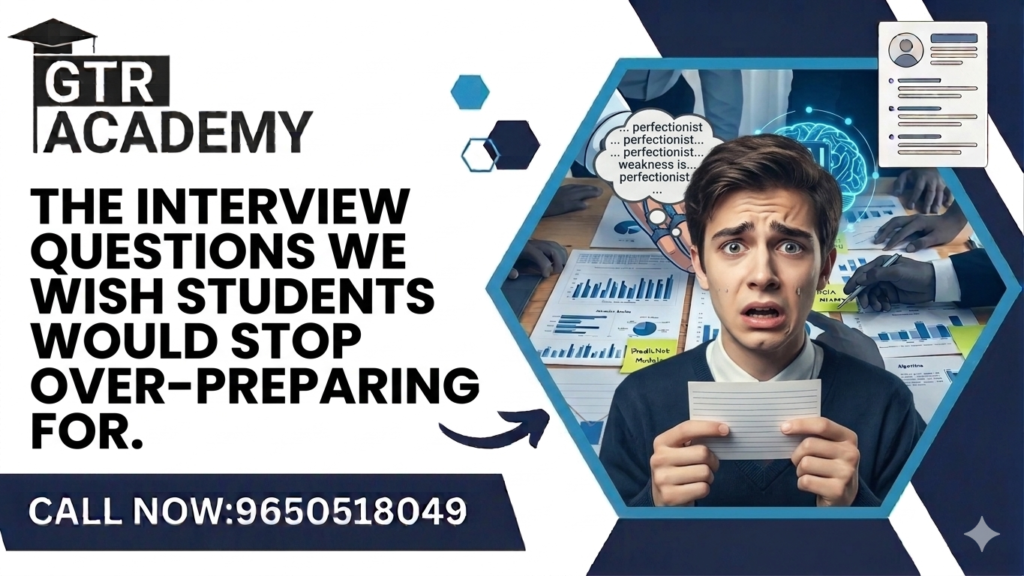
We see it every placement season at GTR Academy: a brilliant student walks into a mock interview, sits rigidly in their chair, and delivers a perfectly memorized, robotic answer to “Tell me about yourself.”
The problem is that in 2026, recruiters are exhausted by scripted answers. They aren’t looking for a “perfect” candidate who has memorized a script; they are looking for a real person who can solve problems. When you over-prepare for the wrong things, you lose the “human” spark that actually gets you hired.
Here is the truth about the questions you are likely stressing over too much—and what you should focus on instead.
1. “What is your greatest weakness?”
Most students spend hours trying to find a “fake” weakness that is actually a strength, like “I’m too much of a perfectionist” or “I work too hard.”
The Reality: Recruiters have heard these a thousand times. They don’t actually care what your weakness is; they care about your self-awareness. Stop trying to sound perfect. Instead, give a real, minor professional struggle and—most importantly—explain exactly what you are doing to fix it. That honesty is much more impressive than a scripted “perfectionist” line.
2. “Where do you see yourself in five years?”
Students often try to predict a specific job title, like “I want to be a Senior SAP Consultant at this firm.”
The Reality: In a fast-changing world, nobody really knows where they will be in five years. Recruiters are actually checking for your “growth mindset.” Instead of a rigid title, talk about the skills you want to have mastered and the impact you want to have made. It sounds more realistic and much more professional.
3. “Tell me about yourself” (The 5-Minute Version)
We often see students recite their entire resume from 10th grade until today.
The Reality: The recruiter already has your resume. They don’t need a audio version of it. They are using this question to see how you communicate. Keep it to 90 seconds. Focus on your “Why”—why you chose SAP, what you’re passionate about right now, and one recent win. Keep it light, keep it brief, and leave them wanting to ask a follow-up question.
4. “Why should we hire you?”
The standard answer is usually a list of adjectives: “I am hardworking, dedicated, and a quick learner.”
The Reality: Every single candidate says this. These words have lost their meaning. Instead of telling them what you are, show them how you fit. Mention a specific challenge that company is facing and explain how your training at GTR Academy has prepared you to help them solve it. Evidence always beats adjectives.
Frequently Asked Questions
1. If I shouldn’t over-prepare, should I just “wing it”?
No. There is a big difference between being “unprepared” and being “over-scripted.” You should know your key points and stories by heart, but you should leave room for the conversation to flow naturally. Think of it like a map, not a set of tracks.
2. What should I do if I get a question I haven’t prepared for at all?
Take a breath. It is perfectly okay to say, “That is a great question, let me think about that for a second.” It shows you are thoughtful. Recruiters prefer a 5-second silence followed by a real answer over an instant, robotic one.
3. Why do recruiters ask these “cliché” questions if they hate the answers?
They use them as icebreakers to see your personality. Often, they are waiting for you to move past the “standard” answer so they can see the real professional underneath.
4. How do I practice without sounding robotic?
Don’t write out full sentences. Write out bullet points of the “stories” you want to tell. Practice saying them out loud in different ways each time. This keeps the core message the same but the delivery fresh.
5. Is it okay to use humor in an interview?
In 2026, a little bit of professional humor can be a superpower. It shows confidence and high emotional intelligence. Just keep it light and make sure it doesn’t distract from your technical credibility.
6. What is the most important question I SHOULD prepare for?
“Do you have any questions for us?” This is where most students fail. Prepare 3-4 deep, insightful questions about the company’s culture or their specific SAP challenges. It shows you are interviewing them just as much as they are interviewing you.
7. Should I memorize my project details?
Yes. Technical details are the one thing you should know inside and out. If you stumble on the “human” questions, it’s fine. If you stumble on how you configured a module, it’s a problem.
8. How do I handle the “What is your salary expectation?” question?
Do your research on the current 2026 market rates for your role and city. Give a range rather than a single number. This shows you are flexible but know your value.
9. Can GTR Academy help me with my specific “interview nerves”?
That is exactly what our mock interviews are for. We put you in a high-pressure environment so that by the time you reach the real thing, it feels like just another conversation.
10. What if I realize halfway through an answer that I’m sounding robotic?
Stop. Smile. Say, “Actually, let me say that more simply.” It’s a great way to reset the energy in the room and shows that you are present in the moment.
Summary Thought
An interview isn’t an exam where there is only one “right” answer. It is a meeting between two parties to see if they can solve problems together. The moment you stop trying to “pass the test” and start trying to “have the conversation,” your nerves will settle. Your value isn’t in your ability to memorize a script—it’s in your ability to think on your feet. Be prepared, but stay human.