

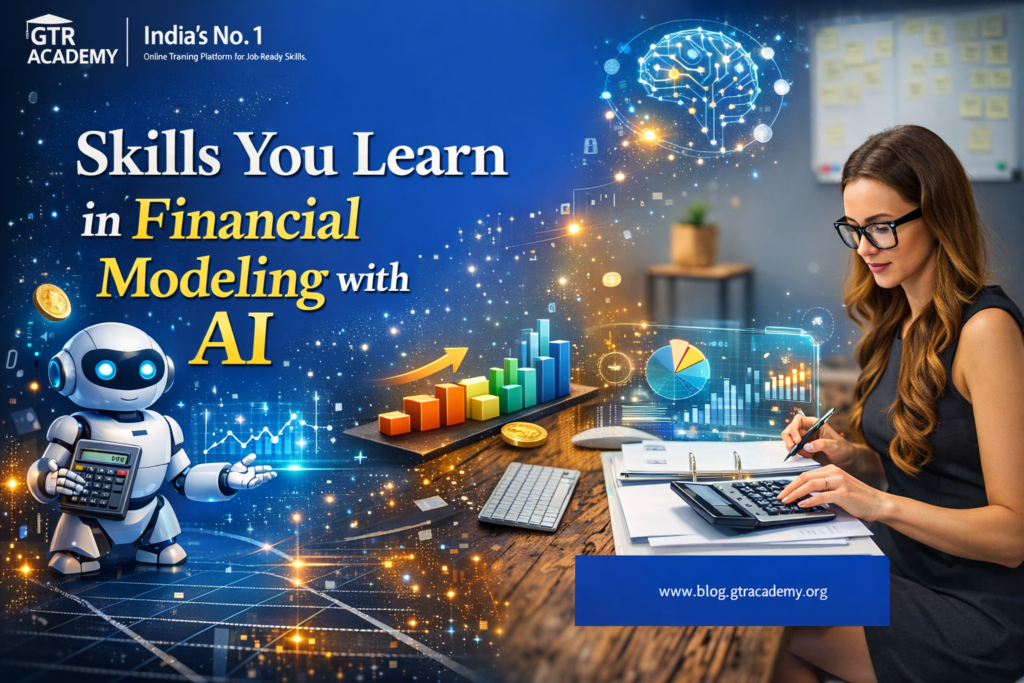
In the fast-paced world of finance, it’s very important to be able to make Financial Models that are accurate, adaptable, and can grow with your business. For a long time, people who work in investment banking, corporate finance, and financial analysis have used financial modelling to help them make choices. As Artificial Intelligence (AI) becomes more common, the world of financial modelling is changing a lot.
People used to make financial models in Excel by hand, changing their assumptions and making new predictions based on different factors. Excel is still a great tool, but AI is making things easier by automating tasks that take a long time and making financial estimates more accurate.
You might be wondering, “What will I learn in a financial modelling course, and how will AI help me get better at it?” In this article, we’ll talk about the most important things you learn in financial modelling with AI and how AI is changing how professionals make, study, and use financial models.
How AI Has Changed Financial Modelling
Before, “Financial Modelling” meant making spreadsheets that showed how well a company was doing with its money. Based on things like sales growth rates, capital expenditures, and profit margins, these models would usually guess how well things would go in the future. But now, AI tools let financial experts go beyond the limits of static models, making processes more flexible, precise, and automated.
A financial modelling course teaches students the basics of modelling. They also learn how to use machine learning, predictive analytics, and big data insights in their models with the help of AI. This makes financial modelling more advanced and able to grow.
Using AI to Teach You Old-Fashioned Ways to Model Finances
You need to know how to model finances the old-fashioned way before you can use AI to do it. If you want to make a Discounted Cash Flow (DCF) model or a Comparable Company Analysis (CCA), you need to know the basics of financial modelling very well.
In a Financial Modelling Course, you will learn standard methods like these:
DCF (Discounted Cash Flow)
Figuring out how much an asset is worth by guessing how much cash it will bring in in the future and bringing that amount back to the present value at a certain rate.
Precedent Transactions
Finding out how much a company is worth by looking at similar deals that have happened in the past.
Comparable Firm Analysis
This means figuring out how much a company is worth by looking at how well other companies like it do.
But AI help makes these methods even better. For example, you can use AI-powered tools to automatically add real-world data to the model, change your assumptions on the fly, and run simulations that test different scenarios. AI can also help you find patterns and trends in old data that would be hard or take a long time to find on your own. AI techniques speed up financial modelling, make it more accurate, and let it adapt to changes in the market.
How AI Makes It Easier to Learn Basic Financial Modelling Skills
One of the best things about learning financial modelling using AI is that it makes the process of learning more fun. AI doesn’t just do the same things over and over again; it also helps you learn hard financial concepts faster and more thoroughly.
In a financial modelling course, you will learn how to use AI tools at work. For instance, AI-powered software might quickly tell you if your guesses and assumptions are wrong, which lets you quickly make your financial model better. This instant feedback is great for learning and getting better at modelling because it lets you try new things and change your approach without having to do the math for every change.
AI solutions can also automatically change when the market changes. If you’re using AI-powered models to figure out a company’s cash flow, they can automatically change important things like sales growth, inflation, or interest rates based on data that is updated in real time. In fields where things change quickly, this level of reactivity is very important.
AI at Work: Using Predictive Analytics for Financial Forecasting
One of the most promising ways to use AI in Financial Modeling Services is predictive analytics. Before, financial forecasting models in Excel made predictions about the future based on data from the past and assumptions. AI can improve this process even more by using machine learning algorithms to analyse a lot of old data, find patterns, and make more accurate predictions about what will happen in the future.
For instance, AI-powered programs might look at a lot of data, like past financial performance and macroeconomic indicators, and use that data to make predictions about how well things will do in the future. This kind of predictive financial forecasting model helps analysts make better decisions about investments, risk management, and business strategy. AI technologies can also look at things outside of their own world, like changes in the economy, interest rates, or market trends. This makes your financial models more full.
How Machine Learning Can Help You Make Financial Predictions
Machine learning (ML), which is a part of AI, is changing how we predict the future of money. Machine learning algorithms can change their predictions based on new data, which gives you more accurate and up-to-date financial information. Traditional models rely on static assumptions a lot.
For example, if you want to guess how much a company’s sales will grow, machine learning models can look at past data and even find seasonal patterns that aren’t obvious at first. These results will help us make better financial forecasting models and better choices about where to put our money.
You will learn how to use machine learning models in your financial models to predict everything from stock prices to market trends in a financial modelling course. You can use these tools to automate the process of making predictions and improve the accuracy of your financial models by using new data.
How to Automatically Make Financial Models: From Excel to AI Tools
You have to build and update your financial model by hand when you use Excel. This process can take a long time and be full of errors. But with AI tools, you can automate a lot of this work, which not only saves time but also makes mistakes less likely.
You will learn how to automate tasks like collecting, cleaning, and updating assumptions in a financial modelling course that uses AI. AI can get data from many places at once, making sure that your financial models are always up to date. When the data is in place, AI tools can automatically change the assumptions based on set criteria or run different simulations to see how different situations would affect the results.
This automation lets you spend less time on the boring parts of building and keeping your financial model and more time on big-picture analysis and decision-making.
How Using Automation in Financial Modelling Saves Time and Makes Things More Accurate
One of the best things about AI-powered financial modelling is that it saves time. Making financial models by hand can take a long time, especially if you have to add new data to them all the time. AI does a lot of the work for you, so you can make financial models in a lot less time than you could with traditional methods.
Also, automation makes things much more accurate. When updating complicated models or doing calculations in Excel financial modelling, it’s easy to make mistakes. You can be sure that your financial models are always correct and up to date when you use AI. This makes financial forecasts and valuation models more accurate, which helps people make better decisions.
Advanced Data Analysis Skills: How AI Helps Us Make Financial Decisions with Big Data
Being able to analyse big data is more important than ever in today’s world of data. AI tools are great at processing huge amounts of data—much more than a human analyst could do by hand. These tools can find patterns, connections, and outliers that traditional financial models might miss.
When making a financial model for investments, for instance, you might want to look at more than just a company’s financial statements. You might also want to look at how well the company does in the market, trends in the industry, and the economy as a whole. AI tools can look at all of this data at once, giving you more information and helping you make more accurate and complete financial models.
Using AI to Get Big Data Insights in Financial Modelling
Big data is changing Financial Modeling Certification by giving us access to more information than ever before. AI can look at huge amounts of data, like how people feel about things on social media or how the economy is doing as a whole, and add this information to your models. AI-powered tools can automatically gather news stories, stock market data, and other useful information to help you better judge a company’s worth or guess how the market will move.
You can make your financial models more flexible by using AI for big data insights. This will help you make better decisions by taking into account a lot of different factors.
AI-Powered Valuation Models: Making the Best Investment Choices
One of the most exciting new things in financial modelling is the use of AI-powered valuation models. Traditional methods of valuing a company, like Discounted Cash Flow (DCF) or Comparable Company Analysis (CCA), depend on people making guesses and entering data. AI tools, on the other hand, let you automate a lot of this work, which makes your investment decisions better.
For example, AI can automatically change the assumptions in a DCF model based on data from the market in real time, or it can run several simulations to see how different situations would play out. You can look at investments more quickly and with more confidence at this level of optimisation.