
There is a lot of noise right now about AI taking over technical jobs. If you are currently training in SAP or thinking about starting, you might be wondering if you are learning a skill that will be obsolete in two years.
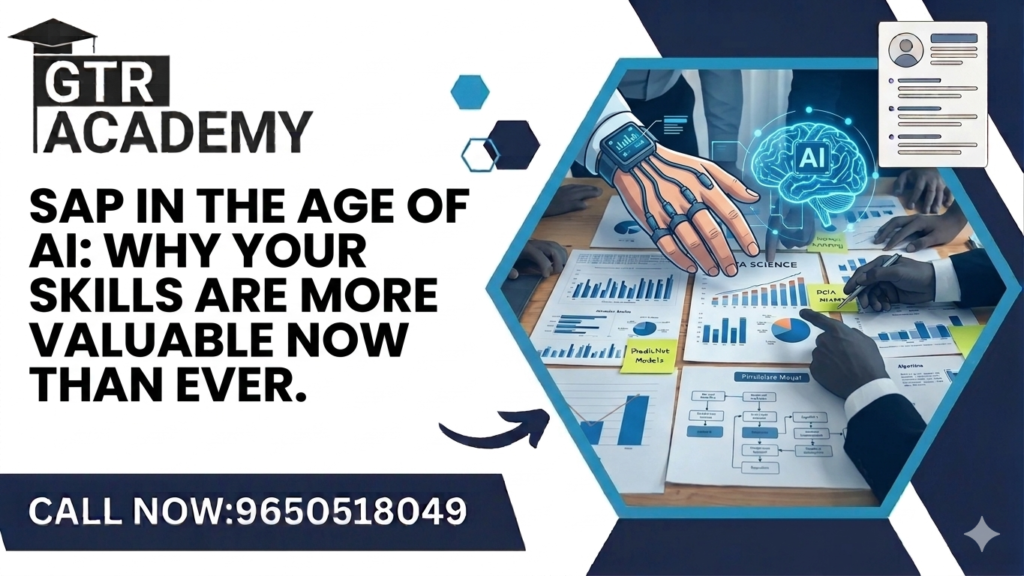
The truth is actually the opposite. In 2026, AI is not replacing SAP consultants; it is acting as a massive spotlight that shows exactly why human expertise is irreplaceable. Here is why your SAP skills are more valuable in this “AI era” than they have ever been.
1. AI Needs Clean Data (And You Are the Architect)
An AI is only as smart as the information you give it. If a company has messy, unorganized data in its system, an AI will give messy, useless answers. This is where you come in. As an SAP professional, you are the one who structures the business processes and ensures the data is accurate. Without your work, the most expensive AI in the world is just a broken calculator.
2. The “Context” Gap
AI is great at spotting patterns, but it has no idea why a business operates the way it does. It doesn’t understand the nuance of a specific Indian tax regulation or why a certain supplier in South India is more reliable than another despite a higher price. You bring the human context and the “business logic” that software—no matter how advanced—simply cannot replicate.
3. From “Data Entry” to “Decision Maker”
In the past, a lot of SAP work involved manual entry and basic reporting. AI is now handling those boring, repetitive tasks. This is actually great news for you. It means your job is shifting away from being a “typist” and toward being a “strategist.” You are now the person who interprets the AI’s findings and tells the CEO, “Here is what this means for our bottom line.”
4. Implementation is a Human Problem
You can’t just “plug in” an SAP system and hope for the best. Every company has a unique culture, different departments, and specific goals. AI cannot sit in a boardroom, listen to three different managers argue about a workflow, and find a middle ground that keeps everyone happy. That is a human skill. Your ability to communicate and bridge the gap between tech and people is your greatest asset in 2026.
Frequently Asked Questions
1. Will AI eventually be able to configure SAP modules on its own?
AI can suggest configurations based on standard templates, but it can’t handle the “exceptions.” Every business has unique rules that don’t fit a standard mold. A human consultant is always needed to verify, test, and customize the system to ensure it doesn’t break the business.
2. Should I learn AI tools along with my SAP training?
Yes, but don’t let it distract you from the core. Think of AI like a powerful new power tool. You still need to know how to build the house (SAP), but the tool (AI) helps you do it faster. Knowing how to use AI to query SAP data will make you a “Super User.”
3. Are companies still hiring SAP freshers in 2026?
Yes, and the demand is higher. Because AI is making companies more efficient, they are expanding faster and need more SAP professionals to manage that growth. The “fresher” roles are now focusing more on analytical thinking than just technical clicks.
4. Does AI make the SAP certification less valuable?
Not at all. A certification proves you understand the foundational rules of the system. AI might help you navigate the system, but the certification tells an employer that you actually understand the logic behind what the AI is doing.
5. Which SAP modules are most “AI-proof”?
Modules that require high levels of human judgment are the most secure. This includes SAP S/4HANA Finance (FICO), SuccessFactors (HR), and Supply Chain (MM/SD). These areas involve complex human emotions, legalities, and shifting market conditions that AI struggle with.
6. How do I show an employer that I am “AI-ready”?
During your interview, talk about how you use AI tools to troubleshoot errors or analyze reports. Show them that you aren’t afraid of the tech, but that you use it to be more productive. This proves you are a forward-thinking professional.
7. Is SAP becoming easier to learn because of AI?
It is becoming more intuitive, but not “easier.” While AI can explain a transaction code to you, it can’t give you the experience of solving a real-world business crisis. That still requires hands-on practice and deep study.
8. Will my salary be affected by AI automation?
For those who only do basic data entry, salaries may stagnate. However, for those who can consult, strategize, and manage systems, salaries are actually rising. In 2026, the “Specialist” is earning a premium because they can do what the AI cannot.
9. Does GTR Academy include AI-related training in the SAP courses?
Yes. We make sure our students are familiar with how modern SAP environments interact with AI. We don’t just teach you the buttons; we teach you how to stay ahead of the technology curve.
10. What is the one skill I should focus on to stay relevant?
Critical thinking. Always ask “Why?” when you are configuring a system. If you understand the business reason behind a technical step, you will always be more valuable than a piece of software that is just following a prompt.
Summary Thought
AI isn’t your competition; it is your co-pilot. The 2026 placement season has shown us that companies aren’t looking for “human robots”—they have enough software for that. They are looking for SAP professionals who can think, adapt, and lead. By mastering SAP today, you aren’t just learning a software; you are learning the language of global business. And that is a language that AI will always need a human to translate.