
Completing a PhD is a long and demanding journey. Years of research, late nights, multiple revisions, presentations, and moments of self-doubt eventually lead to one major milestone – thesis submission. It’s the stage every doctoral scholar looks forward to, yet it often brings the most anxiety.
If you are pursuing an online doctorate, it’s natural to wonder how the Online PhD Program Thesis Submission Process actually works. Is it different from a traditional PhD? Is everything handled digitally? What documents need to be prepared? These questions are common, especially for scholars nearing the final phase.
I’ve seen many researchers feel overwhelmed at this stage – not because their research lacks quality, but because they are unsure about the formal procedures and documentation requirements. The good news is that the process becomes much clearer once you understand the structure.
So let’s break it down step by step and simplify the entire submission journey.
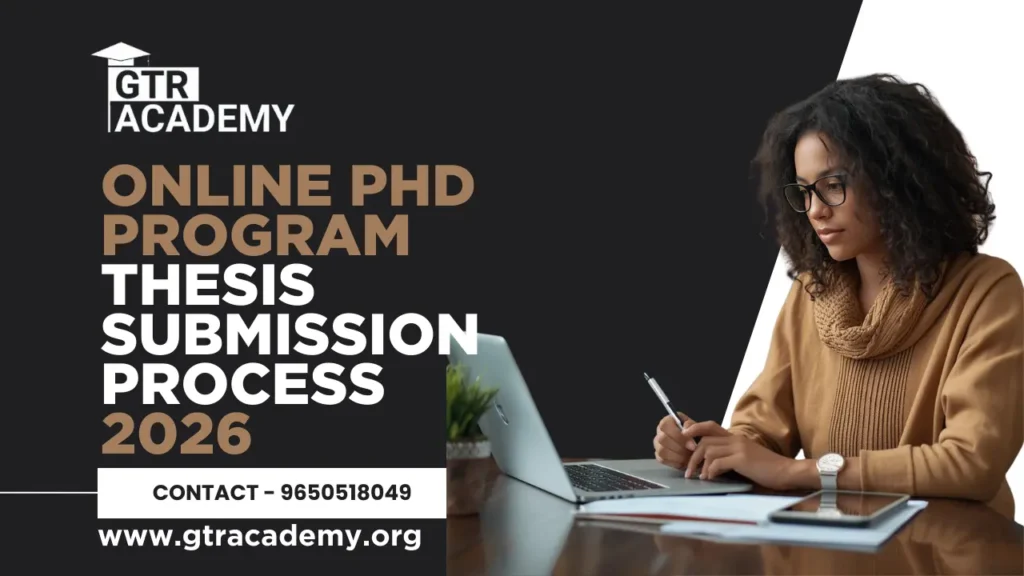
Understanding the Online PhD Program Thesis Submission Process
In an online PhD, your research supervision may happen virtually. Meetings, drafts, feedback – all digital. But when it comes to thesis submission, the process still follows strict university guidelines.
The difference? Most documentation and submission stages are handled online through university portals.
For example:
- PhD Submission Portal DU
- Delhi University PhD Thesis online system
- Institutional repositories like IISc thesis download
- University-specific thesis submission dashboards
Each university has its own structured workflow.
Step 1: Pre-Submission Requirements
Before you even upload your thesis, there are certain academic checkpoints.
Most universities require:
- Completion of coursework
- Minimum research credits
- Publication of research papers
- Pre-submission seminar or synopsis presentation
- Plagiarism check report
If you’re following Du PhD Submission Guidelines, for example, publication in approved journals is often mandatory before final submission.
Don’t wait until the last month to check these requirements. Many students do — and it delays their degree.
Step 2: Formatting the Thesis Properly
One of the most overlooked parts of the Online PhD Program Thesis Submission Process is formatting.
Universities are very strict about:
- Font size and style
- Margin spacing
- Line spacing
- Citation style
- Chapter structure
- Declaration page
- Acknowledgment format
For instance, scholars searching for Delhi University PhD thesis format often realize that even small formatting errors can result in rejection or revision requests.
Before final submission:
- Download official format guidelines
- Review sample theses
- Check margin and referencing rules carefully
Formatting mistakes are avoidable — if you prepare early.
Step 3: Plagiarism Check and Similarity Report
Almost all universities now require plagiarism verification.
Typically:
- Similarity must be under 10–15%
- Excluding references and quotations
A plagiarism certificate must be attached to your submission file.
Without this, your thesis won’t even move to evaluation.
Step 4: PhD Thesis Submission Certificate
This is another essential requirement.
The PhD Thesis Submission Certificate usually includes:
- Supervisor approval
- Research completion declaration
- Originality confirmation
- Institutional verification
Your supervisor must certify that:
- The research work is original
- It meets academic standards
- It is ready for evaluation
No certificate = no submission approval.
Step 5: Online Portal Submission
Now comes the actual digital submission.
Most universities now allow thesis upload through:
- University research portals
- Online PhD submission systems
- Digital academic repositories
For example:
Students looking for Thesis Submission DU must upload:
- Final PDF thesis
- Plagiarism report
- Supervisor certificate
- Synopsis copy
- Abstract
- Publication proof
After uploading, you usually receive a submission acknowledgment receipt.
Keep it safe.
Step 6: Hard Copy (If Required)
Even in online PhD programs, some universities still require:
- Spiral bound copy
- Hard bound final copy after viva
- Library submission copy
Though submission may start online, physical documentation sometimes remains mandatory.
Always confirm with your university.
Step 7: External Evaluation Process
After submission, your thesis is sent to:
- External examiners
- Subject experts
- Sometimes international reviewers
This process can take:
- 3 to 6 months
- Sometimes longer
Examiners may:
- Approve
- Suggest minor corrections
- Suggest major corrections
- Reject
Revisions are normal. Don’t take them personally.
Step 8: Viva Voce (Final Defense)
Once your thesis is approved, you will face the viva.
For online PhD scholars, viva may happen:
- In person
- Or via video conferencing
During viva:
- Present your research
- Answer examiner questions
- Defend methodology
- Justify findings
Confidence matters more than memorization.
Step 9: Final Corrections and Repository Upload
After viva:
- Submit corrected thesis
- Incorporate examiner suggestions
- Upload final version to university repository
Institutions like IISc maintain open repositories (e.g., IISc thesis download) where approved theses become publicly accessible.
This is the final academic step before degree award.
Common Mistakes During Online Thesis Submission
Let me share a few real-world mistakes I’ve observed:
- Waiting too late to check formatting guidelines
- Ignoring plagiarism report until last week
- Not maintaining publication records
- Submitting wrong file versions
- Forgetting signature pages
The Online PhD Program Thesis Submission Process is structured — but small mistakes can delay graduation by months.
How GTR Academy Helps in Thesis Submission
Many scholars feel overwhelmed at this stage.
Institutions like GTR Academy provide structured guidance in:
- Thesis formatting
- Documentation preparation
- Plagiarism correction
- Submission checklist
- Viva preparation
Support during the final phase reduces stress significantly.
Thesis submission should feel like achievement — not confusion.
10 Must-Have Online PhD Program Thesis Submission Process Interview Questions
- What are the key steps in the Online PhD Program Thesis Submission Process?
- Is online submission mandatory in all universities?
- What documents are required before final submission?
- How to obtain a PhD Thesis Submission Certificate?
- What is the acceptable plagiarism percentage?
- How does PhD Submission Portal DU work?
- What is Delhi University PhD thesis format?
- How long does external evaluation take?
- Is viva conducted online for online PhD scholars?
- How can GTR Academy help with thesis submission?
10 Frequently Asked Questions (FAQs)
1. Is thesis submission fully online in online PhD programs?
Mostly yes, but some universities still require physical copies.
2. What is the first step before submission?
Ensure all coursework and publication requirements are complete.
3. How long does thesis evaluation take?
Usually 3–6 months.
4. What happens if plagiarism is high?
You must revise and reduce similarity before submission.
5. Is publication mandatory?
In many universities, yes.
6. What documents are uploaded on the portal?
Thesis PDF, certificate, plagiarism report, synopsis, and publications.
7. Can viva be conducted online?
Yes, many institutions allow virtual viva.
8. What if examiner suggests corrections?
You must revise and resubmit corrected version.
9. When is the degree officially awarded?
After final approval and repository submission.
10. How can GTR Academy support scholars?
They assist in documentation, formatting, submission strategy, and viva readiness.
Conclusion
The Online PhD Program Thesis Submission Process may seem complex in the beginning, but it becomes much more manageable when you approach it step by step. The key is preparation. Start early, follow the prescribed formatting guidelines carefully, maintain all required documentation, stay in regular contact with your supervisor, verify your plagiarism report, and ensure that your final upload is accurate and complete.
Thesis submission is not just a procedural formality – it represents the culmination of years of research, discipline, and intellectual effort. It is the final academic expression of your doctoral journey. With proper guidance and structured support – especially from institutes like GTR Academy – this stage can feel organized, confident, and rewarding rather than stressful.
Remember, your thesis is not just a document. It is your original contribution to knowledge and the foundation of your academic identity.
👉 To understand this topic in detail, read our previously published blog here.