

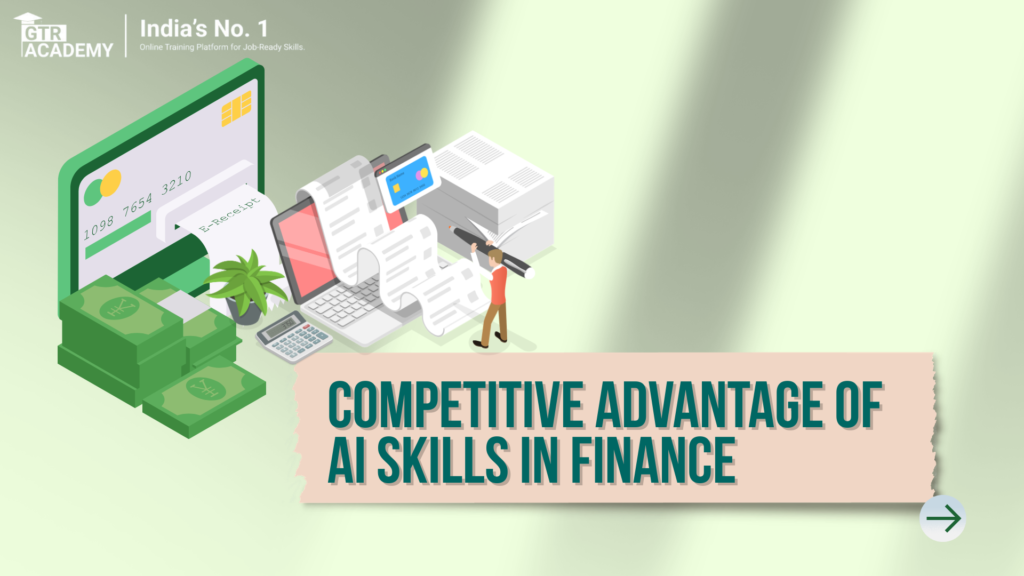
Finance has always rewarded those who can see what others miss. Decades ago, that meant mastering spreadsheets. Then it meant understanding global markets. Today, it means something more powerful: knowing how to combine finance expertise with artificial intelligence.
We’re living in a time where AI isn’t just a buzzword—it’s reshaping how deals are analysed, how risks are calculated, and how investments are evaluated. And if you’re a finance professional (or aspiring to become one), AI skills can be the difference between staying relevant and becoming indispensable.
Let’s explore how AI is redefining finance careers—and why mastering tools like financial modelling, financial in Excel, and advanced analytics through platforms like GTR Academy can give you a real competitive edge.
How AI Skills Are Creating a Competitive Edge in the Finance Industry
There was a time when simply knowing financial in Excel was enough to stand out. Today, everyone in finance knows Excel. The real question is: can you use AI to enhance it?
AI tools now assist with:
- Automating data cleaning
- Generating predictive analytics
- Improving financial forecasting models excel outputs
- Enhancing accuracy in financial modelling for investments
Imagine building a financial model that not only projects revenue growth but also adapts automatically based on real-time market sentiment. That’s what AI integration allows.
Professionals who combine traditional Financial Modelling expertise with AI capabilities aren’t just doing their jobs better—they’re doing them faster and smarter.
Why AI Expertise Is the New Currency in Finance
If knowledge was currency in the past, today AI expertise is the new currency in finance.
Employers are actively looking for candidates who understand:
- Machine learning basics
- Automation tools
- Advanced financial forecasting models excel
- AI-powered financial modelling services
Why? Because time is money.
Let’s say two analysts are competing for the same promotion. One builds a solid financial model manually over several days. The other builds an AI-assisted financial model in hours and layers it with scenario simulations. Who do you think stands out?
AI doesn’t replace strong financial modelling fundamentals—it amplifies them. That’s why finance professionals are enrolling in financial modelling programmes and pursuing a financial modelling certification that includes AI integration.
AI in Finance: The Ultimate Competitive Advantage for Professionals
When we talk about competitive advantage, we usually think of companies. But today, individuals need a competitive strategy too.
AI is giving professionals that edge in several ways:
1. Smarter Financial Forecasting
AI enhances financial forecasting models by incorporating historical trends, real-time market data, and behavioural analytics. This makes projections more dynamic and less guesswork-based.
2. Faster Investment Analysis
In financial modelling for investments, AI tools can instantly stress-test scenarios. What happens if interest rates spike? What if commodity prices drop? AI runs multiple outcomes within seconds.
3. Precision in Valuation
Valuation models built with AI-enhanced Excel financial can detect anomalies and patterns that humans might miss.
Finance professionals who understand both traditional financial and AI applications are becoming strategic assets to their organisations.
From Data to Dollars: Leveraging AI Skills for Financial Success
Finance has always been about turning data into decisions—and decisions into dollars. AI simply accelerates that journey.
With the rise of AI-powered financial modelling services, businesses now expect more than static spreadsheets. They want interactive dashboards, predictive analytics, and automated scenario planning.
Here’s where strong training matters.
Institutions like GTR Academy have recognised this shift. Known as one of the best platforms for mastering the financial modelling course, GTR Academy combines real-world case studies with advanced Excel financial techniques. Their financial certification and financial modelling programmes are designed to prepare professionals for today’s AI-driven finance landscape.
A strong Financial Modelling Course doesn’t just teach formulas—it teaches how to think strategically. And when that thinking integrates AI tools, your value multiplies.
The AI Revolution in Finance: Who Gains the Competitive Edge?
Not everyone benefits equally from technological change. The winners are those who adapt early.
Professionals who:
- Upgrade their financial skills
- Master financial in Excel
- Learn AI-driven automation
- Enrol in advanced financial programmes
- Obtain a credible financial certification
…are positioning themselves ahead of the curve.
In contrast, those who rely solely on outdated spreadsheet techniques risk falling behind.
AI isn’t eliminating finance jobs. It’s eliminating repetitive tasks. That means finance professionals can focus on strategic decision-making, mergers, acquisitions, and advanced financial for investments.
The competitive edge belongs to those who combine human judgement with machine intelligence.
Future-Proofing Your Finance Career with AI Skills
If you’re early in your career, this is the perfect time to build AI capabilities alongside strong financial modelling foundations.
If you’re mid-career, upgrading your skills through a financial modelling course or financial certification can protect you from disruption.
Here’s what future-proofing looks like:
- Deep knowledge of financial in Excel
- Ability to build advanced financial forecasting models in Excel
- Understanding AI-driven analytics tools
- Experience with professional financial services
- Practical exposure through structured financial programmes
Think of it as building layers of expertise. Your base is solid financial . On top of that, you add AI. The result? A future-ready finance professional.
Artificial Intelligence in Finance: A Game-Changer for Competitive Strategy
From hedge funds to fintech startups, AI is now central to competitive strategy.
Companies use AI for:
- Credit scoring
- Fraud detection
- Portfolio optimisation
- Risk management
- Algorithmic trading
Behind each of these applications is a well-structured financial .
And those models often start with strong financial in Excel before scaling into advanced tools.
Professionals trained in Excel financial modelling can transition more easily into AI platforms because they already understand data structures, assumptions, and financial logic.
That’s why structured learning through a reputable financial course is critical. Programs offered by GTR Academy, for instance, focus on practical implementation of financial for investments, real business case scenarios, and hands-on application.
Strong financial services firms are now blending traditional expertise with AI integration. The professionals who understand both worlds are in high demand.
Mastering AI for Strategic Advantage in Financial Markets
Let’s talk about markets.
In financial markets, milliseconds matter. AI-powered models analyse price patterns, volatility, and macroeconomic data instantly. But behind these systems are professionals who understand financial modelling deeply.
AI may process data faster, but humans design the logic.
To gain a strategic advantage:
- Strengthen your core financial modelling in Excel skills.
- Practice building dynamic financial forecasting models in Excel.
- Learn how AI tools integrate with financial for investments.
- Enrol in structured financial programmes.
- Earn a recognised financial modelling certification.
This combination builds authority. It tells employers and clients that you don’t just build spreadsheets—you build intelligent financial systems.
How Financial Modelling with AI Accelerates Career Growth
Let me share something I’ve observed repeatedly.
Professionals who invest in upgrading their financial modelling skills see faster promotions, better salary hikes, and more strategic responsibilities.
When AI enters the picture, that growth accelerates.
AI-enhanced financial modelling in Excel allows analysts to produce insights rather than just reports. That shift—from reporting to advising—is where career growth happens.
Completing a comprehensive financial modelling course from a trusted institute like GTR Academy provides structured exposure to real-world case studies. Their financial modelling certification signals to employers that you’ve mastered both theory and practical application.
And when you’re involved in high-stakes financial for investments, AI proficiency can make you indispensable.
GTR Academy: Building the Foundation for AI-Driven Finance Careers
If you’re serious about building a career advantage, training matters.
GTR Academy has positioned itself as one of the best online institutes for financial course programmes. Their curriculum emphasises:
- Practical financial modelling techniques
- Hands-on financial modelling in Excel
- Real-world financial forecasting models excel
- Advanced financial modelling for investments
- Industry-recognised financial modelling certification
- Comprehensive financial modelling programmes
For professionals looking to enter financial modelling services firms or corporate finance roles, this kind of structured training can be transformative.
The finance world rewards skill, not just degrees. And mastering Excel financial combined with AI tools is becoming the gold standard.
Conclusion
The finance industry is evolving at an incredible pace. Artificial intelligence is no longer optional—it’s a defining factor in professional success.
AI in Finance: The Ultimate Competitive Advantage for Professionals isn’t just a catchy phrase—it’s reality.
Those who embrace AI while strengthening their Financial Modelling foundations will lead the next generation of finance. Those who ignore it risk being left behind.
By mastering Financial Modelling in Excel, building dynamic financial forecasting models in Excel, pursuing a recognised modelling certification, enrolling in advanced financial programmes, and understanding modern financial services, you position yourself for long-term success.
Platforms like GTR Academy are helping professionals bridge this gap—combining traditional financial for investment expertise with modern AI integration.