
Higher educational institutions are no longer what they used to be.
A decade ago, doing a PhD involved getting a new job in another city and changing many aspects of your life by being on campus for years and attending seminars physically. But today, things look completely different. Technology and flexibility have completely reshaped the academic world in ways we never thought possible.
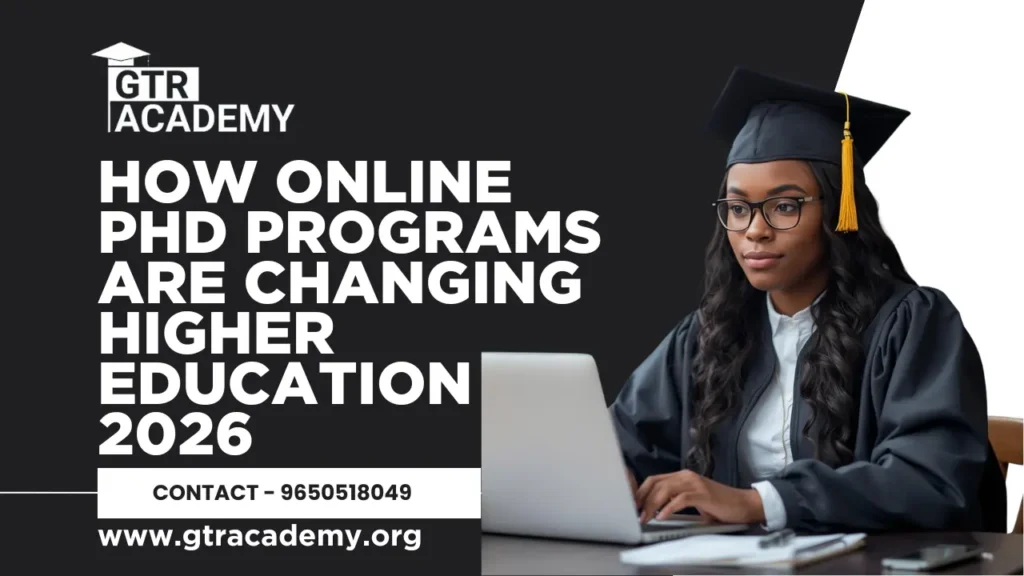
In fact, Online PhD Programs Are Changing Higher Education at a fundamental level. They are redefining who has access to higher education, how research is done, and what academic careers really mean.
Wondering how online doctoral courses are changing the landscape of universities across India and the rest of the world? Or are these changes just a passing phase? Get the answers with our helpful guide.
Now, let’s delve deeper into this metamorphosis.
The Traditional PhD Model: Limited but Prestigious
For many years, PhD programmes proceeded along a predictable routine:
- Presence on campus full-time
- Fixed schedules of research supervision
- Physical access to university libraries
- Limited seats and regional accessibility
While this model carried with it the rigor of academic studies, it also imposed obstacles. Many talented professionals, especially working persons, women managing families, and international learners, could not pursue a doctorate simply because relocation was not practical.
Higher education was prestigious, yet not always accessible.
The Digital Shift: A Turning Point
The pandemic accelerated a change that was already underway. Universities began adopting:
- Virtual classrooms
- Online research supervision
- Digital libraries
- Remote thesis defenses
What started as a temporary adjustment soon proved to be a sustainable model.
This is where we truly saw how Online PhD Programs Are Changing Higher Education 2022 onward, especially in countries like India, where demand for advanced degrees is high but infrastructure is unevenly distributed.
Expanding Access Across India
One of the biggest impacts of this shift is accessibility.
How Online PhD Programs Are Changing Higher Education in India
In India, students from Tier-2 and Tier-3 cities often struggle to access top universities. Relocation costs, housing expenses, and family responsibilities create obstacles.
Online PhD programs have:
- Reduced geographic limitations
- Enabled working professionals to enroll
- Opened opportunities for women balancing family life
- Increased participation from rural regions
Now, a research scholar in Jaipur or Coimbatore can collaborate with professors from Delhi, Mumbai, or even international institutions.
This democratization of education is powerful.
Flexibility for Working Professionals
Earlier, a PhD often meant leaving your job. That’s a huge risk, especially in mid-career stages.
Online doctoral programs allow:
- Weekend seminars
- Flexible research timelines
- Remote mentoring sessions
- Hybrid learning models
Imagine a corporate manager conducting research on supply chain optimization while still working in the same industry. The research becomes practical, immediate, and impactful.
Higher education is no longer separate from professional life—it integrates with it.
Global Collaboration Without Borders
One major shift I’ve personally noticed is the rise in international research collaboration.
Online platforms enable:
- Joint supervision from global faculty
- Virtual conferences
- Cross-border research partnerships
- Access to international journals
Higher education is becoming global, not local.
Earlier, attending an international seminar required travel grants and visas. Today, a doctoral scholar can present research virtually to an audience across continents.
That’s not just convenience—that’s transformation.
Changing Perception of Online Doctorates
There was a time when “online degree” raised eyebrows.
Now, credibility depends more on accreditation than format.
When properly regulated and approved (for example, by UGC in India), online doctoral programs maintain the same academic standards as traditional ones. The difference lies in delivery, not quality.
As more reputed institutions adopt hybrid models, skepticism is gradually fading.
Technology Is Redefining Research
Digital tools are revolutionizing research processes:
- AI-powered data analysis
- Cloud-based collaboration tools
- Online surveys and digital data collection
- Access to global research databases
Research has become faster and more efficient.
A scholar no longer needs to sit physically in a university library for months. Most journals and research materials are now accessible digitally.
This efficiency is one reason why Online PhD Programs Are Changing Higher Education in both structure and speed.
Inclusivity and Diversity in Doctoral Studies
Another important shift is diversity.
Online PhD programs are welcoming:
- Mid-career professionals
- Entrepreneurs
- International students
- Parents returning to academia
- Differently-abled learners
Higher education is no longer limited to early-career academics.
The average doctoral classroom today is more diverse in age, background, and experience than ever before. That diversity enriches research perspectives.
Blending Academia with Industry
In traditional PhD models, research was often theoretical.
Now, many online doctoral scholars focus on:
- Industry-driven problems
- Applied research
- Policy impact
- Corporate strategy development
For example, an HR professional might conduct doctoral research on remote workforce productivity. The research directly benefits organizations.
This applied dimension is reshaping how higher education contributes to society.
Role of Institutions Like GTR Academy
While the model is changing, guidance remains critical.
Choosing the right platform makes a huge difference. Institutions like GTR Academy are emerging as strong support systems for doctoral aspirants. They provide:
- Structured research mentorship
- Academic writing guidance
- Flexible learning formats
- Career counseling
The future of doctoral education depends not only on technology but also on quality mentorship.
{10 Must-Have How Online PhD Programs Are Changing Higher Education Interview Questions}
If you are preparing for a doctoral admission interview, here are important questions:
- How do Online PhD Programs Are Changing Higher Education globally?
- What challenges do online doctoral programs solve?
- How is online research supervision different from traditional models?
- How can technology improve doctoral research quality?
- What are the risks of online PhD programs?
- How do accreditation bodies regulate online doctorates?
- How online phd programs are changing higher education in India?
- What long-term impact will this model have on universities?
- Can online doctoral research match traditional research standards?
- How online phd programs are changing higher education 2022 and beyond?
Prepare thoughtful, practical responses instead of theoretical answers.
10 Frequently Asked Questions (FAQs)
1. Are online PhD programs valid in India?
Yes, if they are approved by recognized authorities like UGC.
2. Do employers accept online doctorates?
Most employers focus on accreditation and research quality, not delivery format.
3. Is online PhD easier than traditional PhD?
No. The research requirements remain rigorous.
4. Can working professionals pursue an online PhD?
Yes, flexibility is one of its biggest advantages.
5. Are online PhD Programs Are Changing Higher Education permanently?
Yes, the shift appears long-term and structural.
6. Is research quality compromised in online mode?
Not if supervision and academic standards are maintained.
7. Do online PhD students attend conferences?
Yes, many conferences are now virtual or hybrid.
8. What is the average duration of an online PhD?
Usually 3–6 years, depending on progress.
9. Are online PhDs recognized internationally?
Recognition depends on university accreditation.
10. Is GTR Academy good for doctoral guidance?
Yes, it offers structured support and mentorship for aspiring scholars.
Conclusion
Higher education is evolving, and it’s not going back.
Online PhD Programs Are Changing Higher Education by making doctoral studies more accessible, flexible, inclusive, and globally connected. They are breaking geographic barriers, integrating industry with research, and enabling professionals to continue learning without pausing their careers. The shift is not about replacing traditional models. It’s about expanding possibilities.
For students in India and across the world, this transformation means one powerful thing: opportunity.
If supported by strong mentorship and credible institutions like GTR Academy, online doctoral programs can maintain academic excellence while increasing accessibility. Higher education is no longer confined to campus walls. It is becoming borderless, digital, and dynamic. And honestly, that might be the most exciting academic shift of our generation.
👉 To understand this topic in detail, read our previously published blog here.