


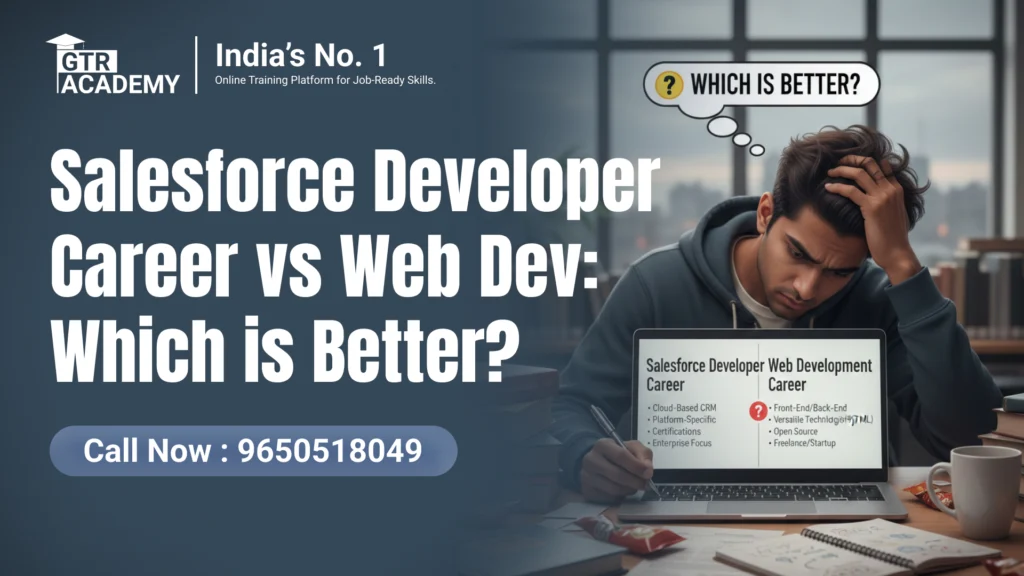
If you’re at a crossroads in your tech career, you’ve probably already asked yourself, “Salesforce Developer Career vs Web Development – which one is better?”
This debate shows up everywhere and even casual conversations between developers. Some people swear by full‑stack web development, while others quietly build highly paid, stable careers inside the Salesforce ecosystem.
So, what’s the truth?
There is no single answer that fits everyone. The right choice depends on your career goals, how you prefer to learn, and the kind of work you actually enjoy doing.
Let’s break this down honestly without hype, buzzwords, or marketing fluff.
Connect With Us: WhatsApp
Getting to Know the Two Career Paths
Before comparing salaries and growth, it’s important to understand what these roles look like in real life.
What Does a Salesforce Developer Do in Real Life?
A Salesforce Developer works on the Salesforce platform to build and customize business solutions. Typical responsibilities include:
- Writing code using Apex
- Building Lightning Web Components (LWC)
- Automating workflows and business processes
- Integrating Salesforce with external systems
- Creating CRM solutions for sales, marketing, and customer service teams
A Salesforce Developer doesn’t just write code. The role is deeply connected to business operations and focuses on solving real‑world business problems.
What Does a Web Developer Do?
Web developers build websites and web applications using a wide range of technologies, such as:
- HTML, CSS, and JavaScript
- Frameworks like React, Angular, or Vue
- Backend languages such as Java, Python, PHP, or Node.js
- Databases like MySQL and MongoDB
Depending on skills and experience, web developers can work as front‑end, back‑end, or full‑stack developers.
Learning Curve: Which One Is Easier to Start?
This is one of the most important questions for beginners.
Learning Curve for Salesforce Developers
Salesforce is a closed ecosystem, which actually makes it beginner‑friendly:
- Clear learning paths
- Guided documentation
- Fewer tools to manage
- Well‑defined certifications
Many professionals from sales, finance, or support backgrounds successfully transition into Salesforce Developer roles.
Learning Curve for Web Development
Web development is powerful, but it can feel overwhelming:
- Hundreds of frameworks and libraries
- Rapidly changing tools
- No single learning roadmap
- Heavy competition
You often need a strong foundation before landing even an entry‑level role.
Bottom line: Salesforce is generally easier to enter, while web development offers more freedom but requires more upfront effort.
Job Market Demand: Stability vs Saturation
Demand for Salesforce Developer Jobs
Salesforce is the world’s leading CRM platform, used by thousands of companies globally.
- Strong and consistent demand
- More job openings than skilled developers
- Long‑term projects and stable roles
Most companies prefer long‑term Salesforce professionals rather than short‑term freelancers.
Demand for Web Development Jobs
Web development demand is high, but so is supply:
- Intense competition for junior roles
- Large freelance market
- Easier entry, harder differentiation
Jobs are available, but standing out takes time and effort.
Salary Comparison: Salesforce Developer vs Web Developer
Money isn’t everything but it does matter.
Salesforce Developer Salary
Salesforce Developers often earn higher starting salaries because:
- Salesforce skills are niche
- Businesses pay a premium for platform expertise
- Certifications increase credibility and pay
In many cases, mid‑level Salesforce Developers earn as much as senior web developers.
Web Developer Salary
Web developer salaries vary widely:
- Entry‑level salaries are usually lower
- Experienced full‑stack developers can earn very well
- Freelancing income can be high but inconsistent
Overall, Salesforce roles tend to offer more predictable and stable compensation.
Long‑Term Career Growth Opportunities
Salesforce Developer Career Path
Salesforce provides a clear growth structure:
- Salesforce Developer
- Senior Developer
- Technical Architect
- Solution Architect
- Consultant or Manager
You can progress without constantly chasing new frameworks.
Web Development Career Growth
Growth in web development depends on:
- Continuous upskilling
- Keeping up with trends
- Personal branding
Some developers enjoy this flexibility; others find it exhausting.
Work Style: Business Logic vs Product Development
Personal preference matters a lot here.
Salesforce Developers:
- Work closely with business users
- Focus on automation and optimization
- Build internal business tools
Web Developers:
- Build customer‑facing products
- Focus on UX, performance, and design
- Often work with startups or agencies
Ask yourself: Do you enjoy business logic or product design more?
Community and Ecosystem Support
Salesforce offers one of the most beginner‑friendly ecosystems in tech:
- Trailhead learning platform
- Strong global community
- Certification‑driven growth
Web development communities are large but scattered. Structure often matters more than size.
Do Certifications Matter?
Salesforce Certifications
Certifications play a major role:
- Highly valued by recruiters
- Clearly validate skills
- Often lead to higher salaries
Web Development Certifications
- Helpful but not mandatory
- Portfolios matter more
- Self‑marketing is critical
If you prefer structured validation, Salesforce has a clear advantage.
Freelancing vs Full‑Time Jobs
Salesforce Developers often get:
- Stable full‑time roles
- Long‑term projects
- Less freelance competition
Web developers have more freelance opportunities, but income can fluctuate.
Which Career Should You Choose?
Choose a Salesforce Developer Career if you:
- Want faster entry into tech
- Prefer structured learning
- Enjoy solving business problems
- Value job stability
Choose Web Development if you:
- Love building things from scratch
- Enjoy creative freedom
- Don’t mind constant learning
- Want freelance flexibility
There is no universally better path only the one that fits you best.
Why Learning the Right Way Matters
No matter which path you choose, how you learn is crucial.
Many students struggle because:
- They follow random tutorials
- They lack mentorship
- They don’t work on real projects
This is where institutes like GTR Academy stand out, offering:
- Structured Salesforce and web development training
- Real‑world project exposure
- Career guidance and interview preparation
The right guidance can save months of confusion.
Questions and Answers (FAQ)
1. Is a Salesforce Developer career better than web development?
It depends on your learning style and career goals.
2. Which career pays more—Salesforce or web development?
Salesforce Developers generally earn more consistently.
3. Can web developers switch to Salesforce?
Yes, many successfully transition.
4. Is Salesforce hard to learn?
Not if you follow a structured roadmap.
5. Is web development oversaturated?
There is heavy competition at the entry level.
6. Do Salesforce Developers need coding skills?
Yes, especially Apex and JavaScript.
7. Can non‑technical people learn Salesforce?
Yes, with proper guidance.
8. Which career offers more job security?
Salesforce roles are generally more stable.
9. Is full‑stack development future‑proof?
Yes, but continuous learning is required.
10. Why choose GTR Academy?
They provide structured, industry‑relevant training.
Connect With Us: WhatsApp
Conclusion
So, which is better: Salesforce Developer Career or Web Development?
The honest answer is simple the best career is the one that aligns with your mindset, goals, and patience level.
A Salesforce Developer Career is ideal if you want structure, stable demand, clear growth, and strong pay. Web development is a better fit if you value creativity, flexibility, and building products from scratch.
Whichever path you choose, focus on quality learning, real‑world projects, and guidance from trusted institutes like GTR Academy. Careers aren’t built on trends they’re built on focus and consistency.