
Imagine this: You are the CFO of a major Indian manufacturing company. It is 2026. You are using a new AI tool to help with your SAP S/4HANA migration. You prompt the AI: “Analyze the risk of our Q3 production data in the FICO module.”
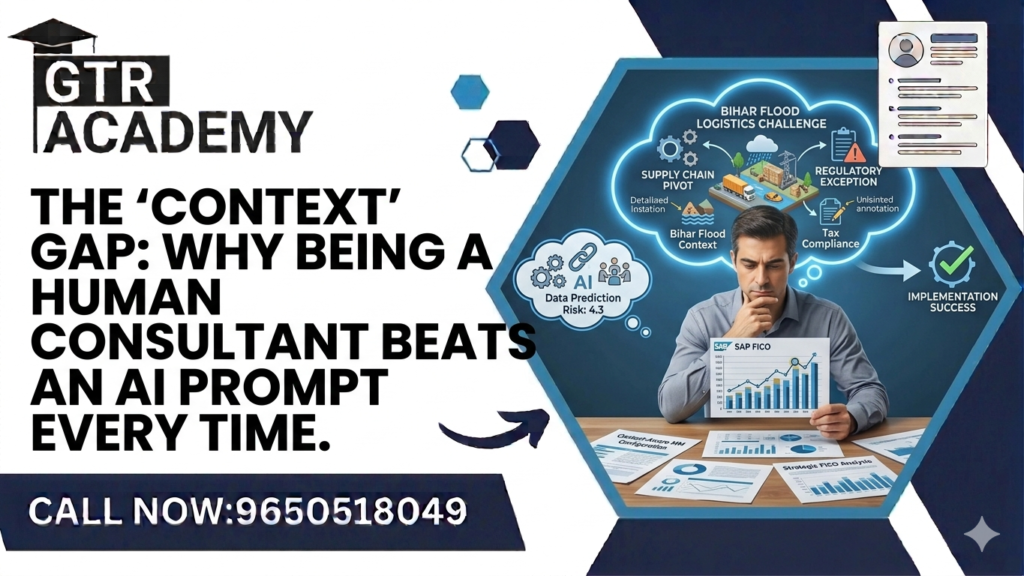
The AI replies instantly: “The Q3 data has 10 discrepancies, a risk factor of 4.3, and a predicted delay of 2 days.” This is all technically accurate data.
Now imagine a human SAP consultant walks in and asks a single question: “Are you aware that the Q3 data was affected by the Bihar flood that shut down your largest factory for three weeks?” The AI didn’t know that. The AI only saw a data dip, not a humanitarian and logistical crisis.
In the fast-moving corporate world of 2026, the “data” is not the bottleneck; the “context” is. This is the ‘Context’ Gap, and it is exactly why your training as a human consultant is your greatest competitive advantage over an AI prompt. Here is why the humans are still winning.
1. Data is Not Understanding
AI can analyze massive data sets faster than any human. But AI does not understand what that data means in the real world. It doesn’t know that a 10% dip in a sales report might be a bad thing, or it might just be because it was a public holiday for 7 days.
The Human Edge: As a human consultant, your job is not to provide data; it is to provide meaning. You can look at a report and immediately ask, “This looks low, but isn’t this the month we launched the new product line?” You bring the “world logic” that software cannot replicate. When you configure an SAP module, you aren’t just clicking buttons; you are mapping out how real people will work in a real environment.
2. Implementation is a Social Problem
You can’t just “plug in” an SAP system. Implementation involves change, and change involves people. Every company has a unique culture, internal politics, and employees who are resistant to new technology.
The Human Edge: AI cannot sit in a boardroom, listen to three different department managers argue about a workflow, and find a middle ground that keeps everyone happy. AI cannot manage conflict, persuade a skeptical stakeholder, or mentor a junior employee through a difficult system change. Your ability to communicate, show empathy, and read the room is what actually gets a system implemented. People trust people, not prompts.
3. AI Can Only See the “Past” and the “Present”
An AI is trained on data from the past to predict the present. It struggles to understand forward-looking, high-stakes strategic choices. If a company wants to launch a radical new subscription model that breaks all previous sales logic, the AI will likely find the idea incredibly risky and illogical.
The Human Edge: You have the ability to dream, to innovate, and to take calculated risks that a computer cannot. You can understand a CEO’s vision that doesn’t exist in any data set. You are the one who tells the company, “The AI says this is risky, but I’ve been analyzing your market, and I believe that if we configure SAP this specific way, we can make it work.” Innovation is a human skill.
Frequently Asked Questions
1. Does this mean AI will never replace consultants?
AI is a powerful co-pilot. It will replace the boring, manual, repetitive parts of a consultant’s job (like data entry or basic technical support). This actually raises your value, as your job shifts from being a “technician” to a “strategist.”
2. How do I show this “context” skill in an interview?
Avoid just stating that you are an “analytical thinker.” Use a specific example from a project. Instead of saying, “I know SAP MM,” say, “When I was configuring the MM module, I didn’t just list material types. I first researched the specific storage and tax regulations for [specific industry] in [specific state] to make sure the data structure was compliant.”
3. If AI is getting so smart, won’t it eventually close the ‘Context’ Gap?
AI will always operate within the “guardrails” of its data and its objective function. It will get better at simulating context, but it will never truly understand it. The “Context Gap” is not a technical problem; it is a fundamental difference between data and lived experience.
4. Why are corporations still so excited about AI if this is the case?
Because AI is incredibly good at what it does: automation, efficiency, and speed. It is making human consultants vastly more productive. Companies aren’t looking to replace consultants; they are looking to hire super-consultants who can manage AI tools to deliver better results, faster.
5. How does GTR Academy prepare me for this specifically?
We don’t just teach you the standard technical procedures. We focus heavily on business communication and strategic thinking. In our labs, we give you “real-world” challenges where the system error isn’t technical, but a business logic error. This trains you to look past the screen and understand the context.
6. Can I be a specialist and still be “adaptable”?
Yes. In 2026, the most valued consultant is a “T-shaped” professional. You have deep expertise in one specific module (e.g., FICO), but a broad understanding of the “entire business context” (MM, SD, the market, the culture).
7. Is “context” more important than technical skill?
They are interdependent. Technical skill is the permission to do the job; context is the wisdom to do it well. You cannot be an expert in context if you do not understand the underlying system. But understanding the system without the context is useless.
8. Is the ‘Context’ Gap why some SAP freshers struggle, even with good training?
Sometimes, freshers are too focused on the “how” (the transaction codes) and forget the “why” (the business goal). Our mock interviews and career coaching focus specifically on closing this gap so you walk into an interview sounding like a consultant, not a student.
9. Does remote work widen or narrow the ‘Context’ Gap?
It widens it. In a remote or hybrid environment, you don’t get the “context” that comes from informal office conversations or a walk to the cafeteria. This means you have to work harder and be more proactive to build that contextual understanding of your client.
10. What is the single most important habit for building contextual awareness?
Curiosity. Never just accept a configuration request. Always ask, “Who is this for? What business process does this solve? What happens if this doesn’t work?” Being an investigator will always make you a better consultant.
Summary Thought
AI is not your competition; it is your accelerant. When you walk into an interview, don’t try to prove you are a faster computer. Prove that you are a better human. You are the one who bridges the gap between the speed of the software and the messy reality of the business world. Technical skills will get you a placement offer, but your ability to see the world behind the data—your command of context—is what will build you a career. In 2026, the person with the most empathy, the best communication, and the deepest understanding of human systems is the person who gets the job. At the end of the day, you can’t build context from a prompt; you can only build it from a life.