
You’ve spent months mastering SAP modules, perfecting your technical architecture, and learning the latest S/4HANA updates. You have the certifications. You have the “hard skills.” And sure enough, the phone starts ringing. Recruiters are impressed by your resume. You’ve cleared the technical hurdle.
But then, the final interview happens. The technical questions stop, and the “scenario” questions begin. Suddenly, the interviewer isn’t asking about transaction codes; they are asking how you handled a project when the client changed the requirements overnight.
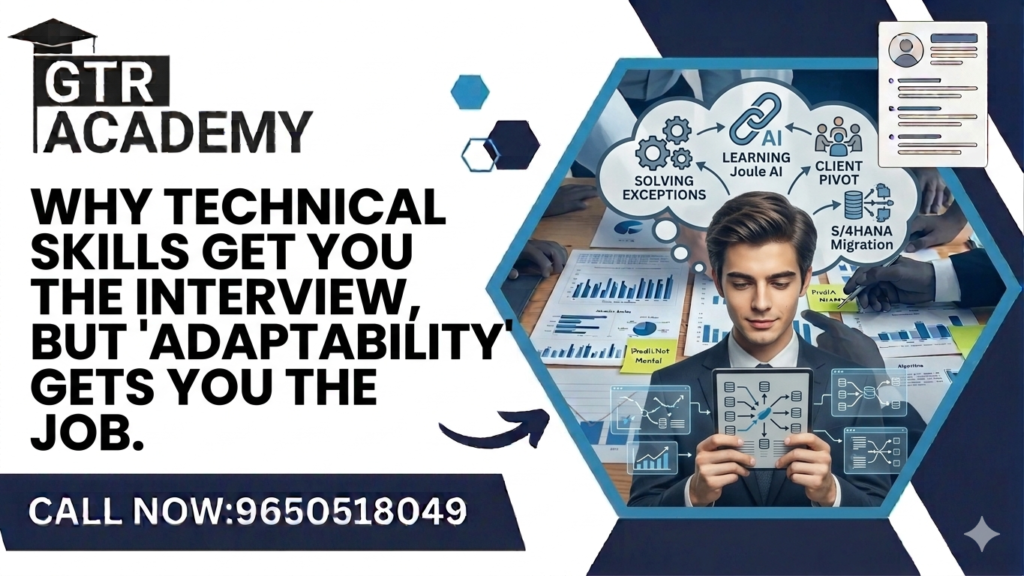
In 2026, we are seeing a massive shift in Indian placements: Technical skills are the invitation, but adaptability is the contract. Here is why being “flexible” is the most valuable skill you can bring to the table this season.
1. The “Playbook” is Always Changing
In the past, an SAP implementation followed a very rigid path. Today, with the rise of AI-driven business and rapid market shifts, the “standard operating procedure” is often rewritten mid-project.
The Adaptability Edge: Companies are no longer looking for someone who only knows how to follow a manual. They want someone who doesn’t panic when the manual is thrown out. If you can show that you view a sudden change in project scope as a puzzle to solve rather than a disaster, you immediately move to the top of the hiring list.
2. AI is Automating the “Fixed” Tasks
If a task is predictable and repetitive, an AI can likely do it (or will be able to soon). What AI cannot do is navigate the messy, unpredictable world of human business.
The Adaptability Edge: When a recruiter sees that you are “adaptable,” they see someone who is AI-proof. They see a professional who can pivot between tools, learn a new AI-integrated workflow in a week, and manage the “gray areas” that software can’t touch. Your technical skill gets you in the room, but your ability to evolve keeps you in the building.
3. The “Culture Fit” is Actually an “Adaptability Fit”
When an interviewer says they are looking for a “culture fit,” they are often checking if you can work with different types of people. Can you speak “tech” to the developers and “business” to the stakeholders?
The Adaptability Edge: Adaptability isn’t just about software; it’s about people. If you can adjust your communication style to fit the person in front of you, you are proving you can survive in a high-pressure MNC environment. Recruiters would rather hire a “B+” technical student who is an “A+” at adapting, rather than an “A+” technical student who refuses to change their ways.
Frequently Asked Questions
1. Does this mean my technical certifications don’t matter?
Absolutely not. Your technical skills are your foundation. Think of it like a car: the technical skills are the engine that gets you moving, but adaptability is the steering wheel. You need both to reach the destination.
2. How do I actually “prove” I am adaptable in an interview?
Don’t just say “I am flexible.” Use the STAR method (Situation, Task, Action, Result). Tell a specific story about a time when a project went wrong or a deadline was moved, and explain exactly how you adjusted your plan to still deliver results.
3. Is “Adaptability” the same as “saying yes to everything”?
No. Adaptability is about being resourceful and finding new ways to achieve a goal. It doesn’t mean being a pushover; it means being a problem-solver who doesn’t get stuck in “the old way of doing things.”
4. Can I learn adaptability, or is it something you’re born with?
It is a muscle. You can train it by intentionally putting yourself in unfamiliar situations—learning a new module outside your comfort zone, taking on a leadership role in a group project, or even just practicing how you respond to “surprise” questions in mock interviews.
5. Why are 2026 recruiters so obsessed with this specifically?
Because the pace of change is faster than ever. A technical skill you learn today might be slightly different in six months. Recruiters are “hiring for potential” rather than just current knowledge. They want to know you won’t become obsolete.
6. What is the “Adaptability Paradox”?
It’s a trend we see where students know they need to learn new things, but they don’t know what to learn because the market moves so fast. The solution isn’t to learn everything; it’s to learn how to learn. Showing you have a “learning process” is a huge green flag.
7. How does GTR Academy help me with this?
We don’t just teach you the SAP screens. We give you “curveball” scenarios in our labs and mock interviews. We force you to handle system errors and client requirement changes in a safe environment so you’re ready for the real world.
8. Is there a “wrong” way to show adaptability?
Yes—by sounding like you have no core principles. You should be adaptable in your methods, but firm in your values and quality standards.
9. Does remote work require more adaptability?
Yes. In a hybrid or remote setup, you have to adapt to different digital tools and find ways to stay visible and connected without being in the same office. Showing you are “digitally fluent” is a major part of 2026 adaptability.
10. What is the best “Closing Thought” to leave an interviewer with regarding this?
“I pride myself on my technical foundation in SAP, but I’m even more proud of my ability to stay effective when the plan changes. I don’t just work with systems; I work with evolving business needs.”
Summary Thought
Technical skills will always be the baseline for a career in SAP. They are the “ticket to entry.” But in a 2026 job market that moves at the speed of light, the person who gets the offer is the one who can look at a shifting landscape and say, “I can work with this.” Don’t just build a resume that shows what you know; build a reputation that shows how you grow. At the end of the day, the most successful professionals aren’t the ones who never fall—they’re the ones who know how to land on their feet.